Australian businesses, compliance professionals, CISOs, and directors frequently grapple with the same question: is SOC 2 mandatory for Australian businesses? The short answer is no. SOC 2 is not required by Australian law, and no regulator will penalise you for lacking it. There is no Act of Parliament and no government body that compels an Australian organisation to hold a SOC 2 report.
Yet for a growing number of businesses, particularly in technology, software, and cloud services, SOC 2 has become close to a requirement anyway, not because a regulator demands it, but because customers do. If a major client or overseas partner asks to see your SOC 2 report before they sign, the standard is effectively mandatory for you, whatever the law says. This guide explains where SOC 2 sits in the Australian landscape, what it covers, when it stops being optional, how it compares to ISO 27001, and how to approach it.
Key Takeaways
- SOC 2 is not required by Australian law, and no regulator enforces it.
- It often becomes a contractual requirement when clients, especially US and enterprise buyers, ask for it.
- SOC 2 is an attestation report, not a certification.
- Most clients want a Type II report, which proves controls worked over several months.
- It complements, rather than replaces, your Privacy Act and Notifiable Data Breaches obligations.
- ISO 27001 is often the better fit for businesses serving mainly Australian or European customers.
Understanding SOC 2
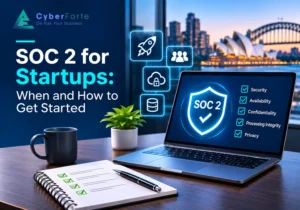
Service Organisation Control 2, shortened to SOC 2, is a compliance framework that assesses how well an organisation manages data against five trust service criteria: security, availability, processing integrity, confidentiality, and privacy. It was developed by the American Institute of Certified Public Accountants (AICPA), which is why it is especially familiar to US-based companies.
A point that trips up many businesses is that SOC 2 is not a certification. You do not receive a certificate. Instead, an independent CPA firm examines your controls and issues an attestation report describing what they tested and found. That report is what you share with clients as evidence that your security practices are real and working. SOC 2 is voluntary by design, but the market has a way of turning “optional” into “expected”.
What Does SOC 2 Actually Cover?
SOC 2 is built on five trust service criteria, and understanding them is the key to scoping the work correctly:
- Security: protection of systems and data against unauthorised access. This is the only mandatory criterion and forms the baseline of every report.
- Availability: whether systems are available for operation and use as committed, which matters most where you offer uptime guarantees.
- Processing integrity: whether processing is complete, accurate, timely, and authorised, relevant to platforms handling transactions.
- Confidentiality: protection of information designated as confidential, such as contracts or intellectual property.
- Privacy: how personal information is collected, used, retained, and disposed of.
Only security is required. The other four are selected based on the commitments you make to customers and the nature of your services, which is why no two SOC 2 reports look exactly alike. Choosing the right criteria at the outset keeps the audit focused and the cost proportionate.
SOC 2 Type I vs Type II
There are two kinds of SOC 2 report, and the difference matters when you plan the work. A Type I report assesses whether your controls are suitably designed at a single point in time: a snapshot confirming the right controls are in place. A Type II report goes further, assessing whether those controls operated effectively over a period, typically three to twelve months.
Because it tests performance over time, a Type II report carries far more weight, and most clients who ask for SOC 2 want one. A sensible path is to treat Type I as a stepping stone, then run your controls through the monitoring period Type II requires. Knowing which report your customers expect before you begin prevents you building toward the wrong target.
The Importance of SOC 2 for Australian Businesses
Although not legally required here, SOC 2 has become a de facto standard, particularly for technology and cloud providers working with US clients or international markets. Australian regulations such as the Privacy Act 1988 promote data practices that align closely with SOC 2, so the controls rarely feel foreign. Industries like healthcare, finance, and IT services benefit most, because their clients have the most to lose from a breach and demand the most assurance. For a SaaS business in particular, a SOC 2 report has become part of the standard toolkit for closing enterprise deals.
When SOC 2 Becomes a Practical Requirement
The gap between “legally required” and “practically required” is where most Australian businesses make their decision. The most frequent trigger is selling to US or international enterprise clients, who routinely require a SOC 2 report as a condition of doing business. A second is the vendor security review: a SOC 2 report answers most of a prospect’s security questions in one document and shortens the sales cycle.
In practice, SOC 2 has effectively become a requirement for your business if any of these apply:
- A client or prospect has asked to see your SOC 2 report before signing.
- You are selling to US or large international enterprise customers.
- You keep receiving long vendor security questionnaires that slow your deals.
- You store, process, or transmit sensitive customer, financial, or health data.
- You sit in a supply chain where the businesses above you are bound by strict security standards.
In each case, the absence of SOC 2 does not attract a fine. It costs you contracts, which is what makes it a genuine requirement in everything but name. If you are already weighing your options, our SOC 2 compliance services in Australia cover the full path from readiness to final report.
How SOC 2 Fits With Australian Regulation
SOC 2 does not replace your legal obligations, but the work rarely goes to waste. Its controls map closely to the practices the Privacy Act 1988 already encourages through the Australian Privacy Principles, so building for SOC 2 strengthens your privacy position rather than duplicating effort. The same applies to the Notifiable Data Breaches scheme: the monitoring and incident-response controls SOC 2 demands are what help you detect and report breaches.
For regulated sectors there can be overlapping expectations. Financial services entities, for example, fall under APRA’s prudential standard CPS 234 on information security. SOC 2 does not satisfy CPS 234 on its own, but the discipline it instils reinforces it. Many businesses also weigh government-aligned frameworks alongside SOC 2; if that applies to you, our guide to Essential Eight compliance is a useful companion, and for defence suppliers our guide on how to get DISP membership covers the parallel requirements.
Benefits of SOC 2 Compliance
- Shortens procurement and vendor security reviews, so deals close faster.
- Provides independent, audited proof of your controls rather than self-assertion.
- Unlocks enterprise and US clients who will not onboard suppliers without it.
- Reinforces your Privacy Act and Notifiable Data Breaches obligations, reducing breach and reporting risk.
In markets where trust is the deciding factor, that combination can be worth far more than the investment required to achieve it.
Common Misconceptions About SOC 2
- “SOC 2 is a certification.” It is not. SOC 2 results in an attestation report, not a certificate against a standard.
- “SOC 2 and ISO 27001 are the same.” They overlap on controls but differ in form, recognition, and the markets that ask for each.
- “A Type I report is enough.” For many enterprise clients it is not; they want a Type II report proving controls worked over time.
- “SOC 2 means we are fully secure.” It shows specific controls are designed and operating, but security is ongoing, not a one-time outcome.
How to Achieve SOC 2 Compliance?
- Identify relevant principles: determine which of the five trust service criteria apply, with security as the mandatory baseline.
- Conduct a readiness assessment: compare current controls against SOC 2 requirements to find the gaps before committing to an audit.
- Work towards compliance: close the gaps, implement controls, document policies, and, for Type II, let controls operate across the monitoring period.
- Undergo an audit: engage a qualified CPA firm to examine your controls and issue the report.
The process can be demanding, and any unresolved weaknesses will surface during the audit. Thorough preparation before the formal assessment is what separates a smooth, first-attempt result from an expensive cycle of remediation and re-testing.
SOC 2 or ISO 27001?
Australian businesses weighing SOC 2 often also look at ISO 27001, the internationally recognised standard for information security management systems. The two share common ground on controls but differ in important ways.
At a glance:
- Outcome: SOC 2 produces an attestation report; ISO 27001 produces a formal certification.
- Recognition: SOC 2 is favoured by US clients; ISO 27001 is widely recognised in Australia and Europe.
- Focus: SOC 2 assesses controls against five criteria; ISO 27001 certifies a whole management system.
- Best starting point: choose the one your customers are actually asking for.
Neither is universally better. If most of your demand comes from Australian or European buyers, ISO 27001 certification may be the stronger place to start. Some organisations eventually hold both, because the overlap means the second is far less work once the first is in place.
How Cyber Forte Helps
Cyber Forte helps Australian businesses decide whether SOC 2 or ISO 27001 better fits their goals, then guides them from readiness assessment to final report. We scope the right criteria, close control gaps before they become audit findings, prepare the documentation your auditor expects, and coordinate the audit itself. As a trusted cyber security company in Australia, we also support related frameworks, so if your needs extend into penetration testing, Essential Eight, or ISO 27001, the same team can plan them together.
Frequently Asked Questions
Is SOC 2 a legal requirement in Australia?
No. SOC 2 is not required by Australian law. It is a voluntary standard that often becomes a contractual requirement when clients or partners ask for it.
Who needs SOC 2 compliance?
Businesses that store, process, or transmit customer data, especially SaaS, cloud, and technology providers selling to enterprise or US clients, are the most likely to be asked for a report.
How long does SOC 2 take?
It depends on your starting point and whether you need a Type I or Type II report. A Type II report covers a monitoring period of several months, so plan that time in from the start.
Is SOC 2 better than ISO 27001?
Neither is universally better. SOC 2 is more common with US clients, while ISO 27001 is widely recognised in Australia and Europe. The right choice depends on what your customers require.
Is SOC 2 a one-time exercise?
No. A SOC 2 report covers a defined period, and most businesses renew it annually so they always have a current report to share.
Is SOC 2 Mandatory for Your Business?
While SOC 2 is not enshrined in Australian law, its importance in the international business landscape makes it a valuable investment for many organisations, particularly those serving enterprise or international markets. The question to ask is not whether the law requires it, but whether your customers do, and whether the deals it unlocks justify the investment.
At the core of SOC 2 lies the principle of trust, a non-negotiable in today’s digital age. To find out how Cyber Forte can help your business achieve SOC 2 compliance in Australia and strengthen your cybersecurity posture, contact us or call 1300 650 063 to speak with our team.