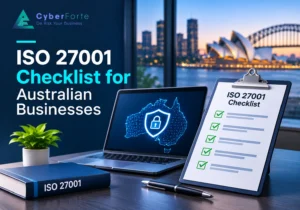
An ISO 27001 checklist breaks a complex international standard into clear, practical tasks your business can complete before its certification audit. For Australian organisations, it covers five areas:
- the management system requirements in Clauses 4 to 10
- the mandatory documents auditors request by name
- the Annex A controls your risk assessment justifies
- the evidence that your ISMS is working
- preparation for the Stage 1 and Stage 2 audits
There’s no official ISO checklist. The controls you need depend on your scope and your risks, so the list below is a planning tool built around the requirements every certified organisation must meet. It’s written from an auditor’s perspective, so you can see what gets checked at each step and where businesses most often fall short.
What is ISO 27001 certification?
ISO/IEC 27001 is the international standard for an information security management system (ISMS). An ISMS is the set of policies, processes and controls a business uses to identify and manage information security risk. ISO 27001 certification confirms that an independent, accredited certification body has audited your ISMS and found that it meets the standard.
Certification is now assessed against ISO/IEC 27001:2022. That edition reduced Annex A from 114 controls to 93 and introduced 11 new controls, including threat intelligence, information security for cloud services and secure coding.
Amendment 1, published in February 2024, added a requirement to consider whether climate change is relevant to your ISMS. The transition period for the 2013 edition closed on 31 October 2025, so certificates issued against the older version are no longer valid.
Why Australian businesses rely on an ISO 27001 checklist
ISO 27001 isn’t a legal requirement in Australia, but more and more organisations are expected to hold it:
- Tenders: procurement teams increasingly ask suppliers for ISO 27001 certification as evidence of mature security.
- International trade: it’s one of the most widely recognised security credentials for businesses selling overseas.
- Regulated sectors: it often operates alongside frameworks such as APRA CPS 234 and the Essential Eight.
- Privacy obligations: a working ISMS helps you meet your responsibilities under the Privacy Act 1988 and the Notifiable Data Breaches scheme.
A checklist matters because auditors look well beyond documentation. They want an ISMS that is properly designed, working day to day and improving over time. Working through each requirement in order is the most dependable way to reach the audit without surprises.
If you’re not sure how close you are to certification, an ISO 27001 gap analysis is the best place to start.
The ISO 27001 checklist: Clauses 4 to 10
Clauses 4 to 10 contain the core management system requirements. Unlike Annex A controls, none of them can be excluded. Every certified organisation must meet all of them.
Clause 4: Context of the organisation
- Document the internal and external issues that affect your information security
- Record whether climate change is a relevant issue, as required by Amendment 1:2024, even if you conclude that it isn’t
- Identify interested parties, such as customers, regulators, suppliers and staff, along with their security requirements
- Define your ISMS scope, including locations, systems, teams, interfaces and any exclusions
Auditor tip: an overly broad scope causes more early delays than almost anything else. Start with the services your customers depend on, then widen the scope at recertification once your ISMS is mature.
Clause 5: Leadership
- Show that top management actively directs the ISMS, rather than simply signing it off
- Approve an information security policy and communicate it to everyone in scope
- Assign ISMS roles and responsibilities, and make sure the people in those roles understand them
Clause 6: Planning
- Document a risk assessment method that explains how likelihood, impact and risk acceptance are determined
- Identify risks to the confidentiality, integrity and availability of information, and assign an owner to each one
- Decide how each risk will be treated and select the controls to address it
- Prepare a Statement of Applicability (SoA) that covers all 93 Annex A controls
- Set measurable information security objectives
- Plan how changes to the ISMS will be managed, a requirement introduced in Clause 6.3
Clause 7: Support
- Allocate the people, budget and tools the ISMS needs to operate
- Confirm and record the competence of everyone in an ISMS role
- Deliver security awareness training to all staff in scope
- Decide what security information is communicated, to whom and how
- Control documented information so only approved, current versions are in use
Clause 8: Operation
- Plan and control the processes your ISMS depends on
- Repeat risk assessments at planned intervals and whenever significant changes occur
- Carry out the risk treatment plan and keep evidence of the results
Clause 9: Performance evaluation
- Measure ISMS performance against your objectives
- Run an internal audit programme that covers the whole ISMS, using auditors who are independent of the areas they review
- Hold a management review that considers audit findings, risks, incidents and progress against objectives
Clause 10: Improvement
- Record each nonconformity and identify its root cause
- Take corrective action and confirm that it worked
- Show measurable improvement in the ISMS over time
ISO 27001 mandatory documents checklist
These documents must exist, be under document control and reflect how your organisation actually works. Auditors will ask for them by name.
| Clause | Document | What the auditor looks for |
|---|---|---|
| 4.3 | ISMS scope | Clear boundaries, interfaces and justified exclusions |
| 5.2 | Information security policy | Approval by top management and evidence it has been communicated |
| 6.1.2 | Risk assessment process | A repeatable method that produces consistent results |
| 6.1.3 | Risk treatment process | A clear link between identified risks and selected controls |
| 6.1.3 | Statement of Applicability | All 93 controls addressed, with reasons for each inclusion and exclusion |
| 6.1.3 | Risk treatment plan | Named owners, timeframes and approval from risk owners |
| 6.2 | Information security objectives | Measurable targets connected to the policy |
| 7.2 | Evidence of competence | Training records and qualifications for ISMS roles |
| 8.2 and 8.3 | Risk assessment and treatment results | Current results, not just a written method |
| 9.1 | Monitoring and measurement results | Proof that performance is genuinely tracked |
| 9.2 | Internal audit programme and results | Coverage of the whole ISMS and recorded findings |
| 9.3 | Management review results | Decisions and actions agreed by leadership |
| 10.2 | Nonconformities and corrective actions | Root causes identified and actions closed out |
ISO 27001 Annex A controls checklist
Annex A of ISO 27001:2022 groups its 93 controls into four themes. You apply the ones your risk assessment calls for.
- Organisational (37 controls): policies, asset management, supplier and cloud security, incident management and threat intelligence.
- People (8 controls): screening, terms of employment, security awareness and remote working.
- Physical (14 controls): secure areas, equipment protection and physical security monitoring.
- Technological (34 controls): access control, encryption, logging, backups, secure coding and vulnerability management.
To build a Statement of Applicability that holds up at audit:
- Base every exclusion on how your business operates. “We don’t develop software in-house” can justify excluding secure coding controls. Company size on its own is never a valid reason.
- Link every included control to a risk. A control with no matching risk in your register points to a gap in your risk assessment.
- Record the implementation status of each control. Auditors sample controls and will ask to see evidence.
- Back technical controls with independent evidence. A CREST penetration test shows auditors that vulnerability management and other technical controls work in practice.
Certification audit checklist: Stage 1 and Stage 2
An independent certification body conducts your ISO 27001 audit and issues the certificate. Before engaging one, check that the body and the relevant scope of accreditation appear on the JAS-ANZ register, or are accredited by another IAF-recognised body. That way your certificate will be accepted by customers and tender panels.
Stage 1: documentation and readiness review
- Scope, policy, risk assessment, SoA and risk treatment plan are finalised
- At least one complete internal audit and one management review have taken place
- The people responsible for the ISMS are available to walk the auditor through it
Stage 2: implementation and effectiveness review
- Evidence shows controls have operated over time, not just that they were set up
- Staff can explain their security responsibilities when the auditor interviews them
- Findings from Stage 1 have been resolved
- A corrective action process is ready for any nonconformities raised
After a successful Stage 2 audit, your certificate is valid for three years. Surveillance audits take place in the second and third years, followed by a full recertification audit.
The nonconformities auditors raise most often
The same problems appear again and again at certification audits:
- Incomplete internal audits. Clause 9.2 requires the internal audit programme to cover the entire ISMS, not just a sample of it.
- Template risk assessments. Generic risks that don’t relate to the business’s real assets rarely get through Stage 2.
- Weak Statement of Applicability reasoning. Exclusions without a genuine reason, or included controls with no supporting evidence.
- Policies without practice. Documents describing processes nobody actually follows.
- Missing or thin management reviews. Reviews that skip required inputs or produce no recorded decisions.
- No climate change consideration. Businesses relying on templates written before 2024 often miss the Amendment 1 requirement.
How long does ISO 27001 certification take?
The timeframe depends on your scope, size and how mature your current security practices are. With a clearly defined scope and end-to-end support, Cyber Forte helps organisations achieve ISO 27001 certification in as little as 6 to 8 weeks. Larger organisations, or those starting with few controls in place, should plan for longer.
For related reading:
- Budgeting: see our guide to ISO 27001 Certification Cost in Australia: What to Expect in 2026
- Startups: Read ISO 27001 Certification for Startups
- Choosing a framework: Check ISO 27001 vs Essential Eight
Frequently asked questions about the ISO 27001 checklist
No. ISO doesn’t publish one, because the controls each organisation needs depend on its scope and risk assessment. A reliable checklist follows Clauses 4 to 10, the mandatory documents and the Annex A controls your risks justify.
The core mandatory documents are:
- the ISMS scope
- the information security policy
- the risk assessment and risk treatment processes
- the Statement of Applicability
- the risk treatment plan
- information security objectives
- evidence of competence
- monitoring results
- internal audit results
- management review results
- records of corrective actions
No. You implement the controls your risk assessment identifies as necessary, and record your reasoning for every inclusion and exclusion in the Statement of Applicability.
Independent certification bodies issue ISO 27001 certificates. Choose one accredited through JAS-ANZ, or another IAF-recognised accreditation body, so your certification is widely accepted.
Amendment 1:2024 requires organisations to consider whether climate change is a relevant issue for their ISMS, and whether interested parties have climate-related requirements.
Turn your ISO 27001 checklist into a certificate
Cyber Forte’s ISO 27001 Lead Auditors guide Australian businesses from gap assessment to certification, with fixed pricing and an AI-powered compliance platform included. Organisations that follow our process achieve certification on their first attempt, or we continue working at no extra cost until they do.